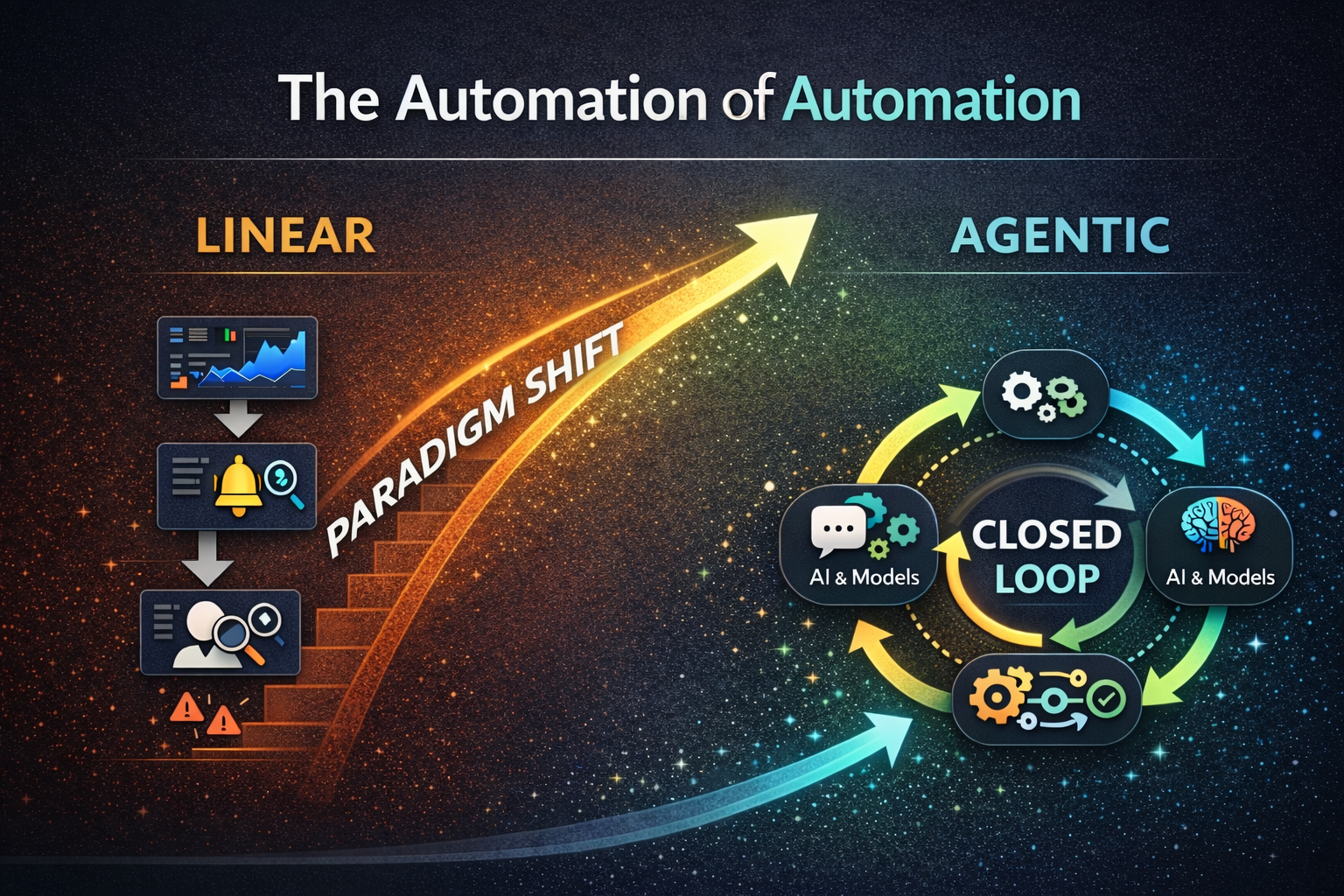
The Automation of Automation, Accelerated
In November 2023, I wrote about The Automation of Automation and since then this has grown exponentially, fundamentally changing our world in ways we don’t even understand yet. Conceptually this was just that it was becoming easier and easier to connect automations together. This was being accelerated tremendously by Generative AI.
The result is not just faster workflows or smarter tools—but an unprecedented acceleration in how knowledge, decisions, and capabilities propagate across humans and machines. This article explores why that acceleration is happening now, why it feels fundamentally different from anything before it, and why our ability to adapt is lagging dangerously behind our ability to build.
Automation No Longer Ends at Output (and Keeps Accelerating)
What changed since 2022/2023:
- Automation used to stop at output (dashboard, alert, report, human review).
- Now outputs re-enter the system as inputs to prompts, rules, models, and workflows.
- This created closed-loop, self-reinforcing systems.
It is very important to note that these changes did not occur as independent trends or linear steps. They layered on top of each other, with each new capability amplifying the previous ones, creating compounding effects rather than just additive progress.
Key accelerants:
- AI shifted from feature to a control layer (orchestrates tools, not just an assistant).
- Agentic systems operationalize this: goal → decompose → execute → validate → retry/escalate.
- Humans can now provide intent, not steps.
Critical point:
- This is not a single jump. The loop frequency is increasing continuously.
- Each iteration shortens feedback cycles and reduces current human manual gating.
Ambient automation (always-on, invisible automation):
- Many automations are invisible, default, and assumed (e.g., Chrome Read Aloud).
- No workflow builder. No setup. Automation is discovered, not designed.
Beyond Automation: The Connectivity of Connectivity (MCP Effect – One Year Later)
Why “Automation of Automation” is no longer sufficient as a label: automation explains execution, but it does not fully explain access. The introduction of the Model Context Protocol (MCP) was an inflection point:
- Introduced by Claude around November 2024.
- Standardized, low-friction connectivity between LLMs and systems.
- Reduced integration effort from days, weeks, or months to minutes.
Why this massively accelerated connectivity and access to silos of data and knowledge:
- Traditional APIs were brittle, bespoke, slow, and constantly changing.
- MCP-style connectors are persistent, reusable, and conversational.
- Once connected, access is continuous for all future LLM interactions.
Connectivity of Connectivity:
- LLM ↔ tool ↔ data ↔ system ↔ LLM
- Each new connector increases the value of all existing connectors.
- This is network effects applied to knowledge access, not just social graphs.
Concrete signal:
- ChatGPT “+” menu evolving weekly and monthly.
- Claude connectors (Drive, Calendar, Gmail, MCP servers) expanding rapidly.
- Years of Docs, Sheets, and Slides accessible in seconds via natural language.
Implication: This is not just faster automation—it is persistent access to previously siloed structured and unstructured information, representing a massive expansion of LLM cognitive reach.
Acceleration of Automation of Automation (Agentic + Connectivity)
We have never seen this level of accelerated service, product, and knowledge evolution occur at this pace—or compound this quickly. What makes this moment different is not just better tools, but the continuous stacking of capability on top of capability.
- Each new connection, agent, or context layer becomes immediate input to the next wave of systems.
- Years of learning, integration, and iteration compress into days—or minutes.
Result: system evolution speed now exceeds human governance speed.
Why agentic systems mature faster:
- Agents don’t just act—they pull context continuously.
- Connectivity allows reasoning across tools, data, history, and state.
- This turns agents into persistent operators, not task runners.
The real bottleneck:
- Technology readiness ≫ human adoption readiness.
- Org structures assume manual control and linear approval.
- Humans struggle to trust systems they cannot mentally step through.
The real risk (not job loss):
- Self-reinforcing error loops.
- Unvalidated data amplified autonomously.
- Optimization without ethics or brakes.
- Garbage in → garbage multiplied.
Unlike previous technology cycles, this acceleration spans software, data, services, workflows, and human decision-making simultaneously. Knowledge no longer advances in discrete releases—it evolves continuously through systems that observe outcomes, adjust behavior, and re-execute. We are no longer just automating work; we are accelerating how knowledge itself is created and applied—faster than humans and institutions can realistically govern.
Coming Soon Concepts / Articles (a challenge to me)
- The Connectivity of Connectivity
- The Acceleration of the Agentic
- Fixed Mindsets in a Non-Deterministic World
PS: This article was a Human + AI + Human + AI + Human + AI + Human + AI + Human + AI + Human + AI + Human + AI + Human + AI + Human collaboration back and forth.
Thanks for reading or listening. Hit me up in a DM or the comments if you have other thoughts on the core concepts. Buckle up—we are all in for some type of AI ride.